Saturday, February 6, 2010

Remembering where I am


In the months that I've been here in Colombia, I have been a little frustrated by how insular I feel like my existence has been. The reality is that I spend most of my time at school and work a LOT at home. Many of my friends live on the northern side of Bogotá, where I do. We mostly go out to places on this side of town. So, getting out of my convenient comfort zone means making a deliberate point to take the time to get out and explore different parts of the city.

A couple of my friends and I did that last weekend. Even though it may sound funny since we actually live here, we went on an organized bike tour of Bogotá. It was great. It was the most perfect, sunny day, and we started down in La Candelaria, the lovely old colonial center of town. We wound our way through the colonial and government buildings, in and around a number of parks (at least one of which was made way for by razing a crime-ridden neighborhood, of course) and through bustling neighborhoods I had never been to or heard of. We made a stop at the central market, called Paloquemao, where I had one of the best arepas I've ever eaten and where we snacked on tropical fruits ranging from mangosteens (my favorite), to pitaya, to passion fruit. It made me so envious of my friend Moira, who gets to do her fruit and vegetable shopping there. From the market we continued on to the Central Cemetary, which is just as segregated by social class as any other one I have ever visited in Latin America. Next door was a series of crypts that had been emptied in preparation for demolition, but not before they were painted with silhouettes of bodies being carried on stretchers -- representing the dead of Colombia's armed conflict. We wound down our trip with a stop at the National Park before heading down the Ciclovía (the route of streets that are closed on Sundays to make way for bikers and pedestrians) back to La Candelaria. It was a perfect way and a perfect day to see other parts of the city. Turns out that it was also the perfect day to get the kind of sunburn you can only get by forgetting to wear sunscreen at 8500 feet.
My tour around Bogotá got me thinking about my insulation on a bigger scale. I think it was partly a question of timing. In the couple of days following that bike ride, I read about a new Human Rights Watch report about the successor groups of the paramilitaries here who continue to commit atrocities, got an update from a friend attending the trial of 10 army officers for complicity with paramilitaries in a massacre in a peace community a few years ago, and met three members of the U'wa indigenous group who are engaged in a struggle with the oil company Ecopetrol to prevent oil drilling on their native land. This is the country where I live, and I have been woefully uninformed about events here.


So I've made a belated New Year's resolution to commit myself to learning more about Colombia's history and to staying much better informed about what is going on here today. It's fine that I got a book on Colombian history recommeded to me by the woman in my department who teaches that class at school, but I know better than anyone the best way to get a first-hand crash course in the reality of any country in Latin America: go on a Witness for Peace delegation. I am so incredibly excited since I have decided to join (OK, I have to apply, but I am hoping that as a former staffer I will be accepted) a group in July that will travel to the Urabá region to learn about the situation facing people living in so-called humanitarian zones. According to the description on the Witness for Peace web site, "A humanitarian zone is a living area of a few acres surrounded by a barbed wire fence. The community puts signs on the fence proclaiming that this is a civilian zone, and nobody with a weapon is allowed inside. Because threats [from paramilitaries and the army trying to take over their land] continue, these communities rely on international attention for their survival."

I know I have a lot to learn, but I feel good for having committed myself to taking active steps to really remember where I am.

(To see some of the testimonials from the Human Rights Watch report, you can follow this link: http://www.hrw.org/en/feature/colombia-deadly_threat)

Monday, January 25, 2010

Bogotá birthday

So I am 35 now. As my friend Michael (who also just turned 35) pointed out, I am now halfway to 70. Thanks, Michael.

My shock at my old age notwithstanding, I was excited to mark my birthday, to mark a year of big changes and fresh starts, in the city I now call home. I figured that I would just do something small with a few Bogotá friends, new and old. What I couldn't have expected, what was the best surprise, was that I would be visited by the ghost of birthday past.


Many, many years ago, my family moved from Rome ("The Eternal City") to Findlay, Ohio ("Flag City, U.S.A."). I think most of you reading this have heard the story, so I'm not going to go into all the heinous details. What you may not have heard in the telling, however, is that there were people I met in Findlay who were a breath of fresh air during that dark period of my late adolesence. One of them was a guy named Andrew Evans. I met Andrew at the beginning of my senior year because he had spent our junior year as an exchange student in France. It's fair to say that we were kindred get-me-the-hell-out-of-this-town spirits from the start. That being the case, it is perfect that we would see each other for the first time in 17 years here, in Bogotá, on my 35th birthday.

[Insert plug for how cool Andrew is here: Andrew was in Bogotá because he is working on a project for National Geographic, namely traveling the length of the Americas by bus (and boat where necessary) in order to catch a boat to Antarctica in February and blogging/tweeting as he goes. His blog is insightful and funny, and I highly recommend it anyone who can only afford a vicarious trip to the South Pole. http://blogs.nationalgeographic.com/blogs/intelligenttravel/bus2antarctica/]

Intrepid traveler that he is, Andrew found his way to Andrés Carne de Res, Bogotá's world-famous, one and only freak show/steak house. This place really does defy description. The décor can best be described as Latin American religious kitsch-meets-Frida Kahlo's nightmare. There is weird stuff on the walls. The art work and logos are trippy, and sometimes the waiters and waitresses dress up in costumes. And afterwards there's a dance party. It should be pretty clear why I wanted to celebrate here.

Though things did get a little silly when one of the waiters in some kind of get-up brought me a plastic cake and made me dance (see attached video), the night was actually pretty tame. Andrew dispensed travel advice to my friend who's planning a trip to southern Africa; my friends dispensed travel advice to Andrew who is traveling by bus through a country that is at war. I drank too many too strong mojitos, reveled in the good company, and just felt lucky to have great friends, no matter how old I am.


Saturday, December 19, 2009

More from the Amazon

I have to write more about our days in Puerto Nariño, the jumping-off point for our jungle adventures. Forgive me the length of this post. It's just that there is so much to tell.

The first day we went on a boat trip to Lake Tarapoto, home of the famous pink dolphins. We only saw a couple that were kind of purple but to cruise down the Amazon in a little motor boat was incredible. We stopped in an indigenous village and later went for a swim in the river's very murky waters. I was sure something was going to attack us, but we emerged unscathed by either pirañas or any other scary critter.

The next day was our first big hike, this one to a different indigenous community called San Martín. It was a three-hour trek through the most mosquito-infested place I have ever been. They positively swarmed around us. On an otherwise tranquil hike, we did have a slightly nerve-wracking moment when we unexpectedly hit the end of the trail -- not where we were supposed to or where the boat was supposed to meet us. Fortunately, we came across a local Ticuna man, his hands and face painted a dark blue color from a plant dye used by indigenous people in the area, with a dugout canoe who ferried us across a stream so we could continue our trek. When we finally made it to San Martín we were greeted by, among other curious onlookers, by a toddler yelling "Turistas!" as we passed. It was hilarious yet disturbing at the same time. The kind of surreal experience continued as the local drunk insisted on being our tour guide through the community. Finally -- when, I swear, I didn't think I could walk another step in the rubber boots we had to wear for this muddy hike -- we headed back to Puerto Nariño by boat.

Our last full day in Puerto Nariño we went on a much more hard-core, much more jungly hike. We tromped through mud and grasses taller than us. We ate wild grapes and tasted some local yucca moonshine-like drink (not particulalry tasty). We walked through several communities (one complete with soccer field and covered bridges) in the middle of nowhere. Again, the silly-looking and spectacularly uncomfortable rubber boots proved to be the best $7.50 I've spent in a while. It was worth every step in them, following our guide Saúl who cleared the path with his machete when necessary and taking in the green that surrounded us and the blue sky when we could see it.

Now we are back in Leticia, winding down our trip -- but not before we go to Peru for a ceviche lunch. Last night's stay in the indigenous community didn't happen because it was actually REALLY expensive. So instead, we walked across the border to Brazil to try some Brazilian beer (far superior to Colombia's most popular brand, Aguila) and to buy some Hawaiana (i.e. kind of trendy (?) and over-priced in the States) flip flops and $3.50 cahaça. I see homemade caipirinhas in our future.

In sum, if you ever have a chance to come to this sweltering part of the world -- home to skies that seem bigger than in other places, even when the daily rain clouds roll in, as well as to this enormous river that cuts through a dense jungle populated by isolated communities of indigenous people trying to both preserve and share their customs and traditions -- take it. You will feel as lucky as I do to have been so far from the rest of the world and seen such wonderfully different things.

Friday, December 18, 2009

Amazon dispatch

Just a brief update from the sweltering Amazon.

This trip has been as fun and random and restful and restorative as I had hoped. Moira, Evan, and I have been to Brazil for dinner, gone dancing with two Colombian policemen (?!), and eaten meat on a stick -- and that was all on our first night. On day two we got poured on (big shocker in the rainforest) while kayaking on a tiny Amazon tributary.

We are just back from the jungle and as stinky as you would expect. But we had two incredible, loooong, sweaty jungle hikes in our stylin' new rubber boots and are headed tonight to stay in an indigenous village outside of Leticia. I expect that for dinner we will have fish and fried plantains (patacones), which I have eaten twice a day, everyday since I got here. I am about to turn into a patacon. Tomorrow we are determined to have ceviche for lunch -- in Peru.

There is so much more to tell, but it will have to wait til I get back to Bogotà with a better connection and a less crappy keyboard.

Sunday, December 13, 2009

Adventure!

I had been afraid that I would fall off the blog writing wagon at some point, and I certainly did. For what it's worth, the last couple of months have been a blur of work and work, with some time with great new friends sprinkled in there. I mean, I could have written more about how Colombian social and economic inequality are demonstrated every day at my school or how I was struggling to keep up with my Modern World History class, trying to teach the Vikings and the Mongols for the fist time. But I didn't.

So now the semester is over, and I have just embarked on a trip to the Amazon. I arrived in Leticia today. It's the "big" town in the region -- a grid of tiny streets swarming with motorcycles. (I almost got run over by one in my first 5 minutes here. I mean really close).

We flew in over the rainforest, which was pretty amazing. A sea of green as far as the eye could see, interrupted here and there by barren patches with felled trees, which was a good reminder of how hard life can be in this remote area. When I stepped off the plane my glasses fogged up; it is THAT hot and humid here. Not that I didn't expect it, but. . . Not to over-share, but ladies, you'll understand this. It's so hot that you get that insta-under-boob sweat. Not to mention that my hair is already plastered to my head.

While I wait for my friends Evan and Moira to arrive, I am getting settled in town and at the hostel where we're staying. It's 9 blocks from the river (which I haven't seen yet) and about 7 from Brazil.

Signing off to go find some exotic fruit juice. I think this is going to be a great trip.

Saturday, October 24, 2009

The cumbia of the disconnected

This is a belated post about another part of my trip to Medellín: a small protest that I went to with a friend who works for a human rights organization here in Colombia. (You can check out their work at http://forcolombia.org/). The event was set up by a regional coalition of human rights and community development groups and was protesting increased privatization and price hikes in public utilities, both of which make them prohibitively expensive and means that many people end up without water or electricity services.

After a breathtaking and, OK slightly scary, ride up Medellín's cable car I arrived in one of the comunas, Medellín's poor neighborhoods built up the steep side of the mountains that surround the city. Organizers had decided to do the march in the neighborhood rather than in the city center in order to spread awareness among other people affected by the price hikes, letting them know that people are trying to resist them. My friend and I met up with the marchers and started walking along with them. The organizers had made this event a festive one. There were lots of kids running alongside, young boys on stilts, lots of drums, and clowns in tutus. The march was a short walk and didn't have a huge number of participants, but did have a lots of spectators hanging out the windows and sitting on balconies of their homes. The march ended in a litle parking lot, where a guy with a microphone read the banners as they came in and where, eventually, salsa music kept the party-like mood going. One of the best moments was when they played a song someone had written called "The cumbia of the disconnected," a cumbia (another music/dance style here that gets played along with salsa in dance clubs). Despite its upbeat rythmn, the song was a lament about having to decide between buying food and paying the bills.

The event wound down -- with salsa still playing in the background and some people dancing -- with an invitation for everyone to share some bread and cheese and hot chocolate from a giant vat. It still felt like a party, but as scraggly-looking kids came out of the woodwork for some food, it also reminded me of how many people here are hungry.

All in all, the march gave me a chance to feel a little less ignorant about the problems here and about how people at every level are struggling to make Colombia's a less unequal society. I was a million miles from the immaculate and manicured campus of my school, and frankly, I was glad to be there for a change.

Thursday, October 15, 2009

Medellín: where orchids grow wild & the mullet is alive and well

My trip last week to Medellín was just a chance to get a change of scenery and visit a new place. After hearing rave reviews, I have to admit I was underwhelmed. I'm not exactly sure what I expected, but it wasn't that.

Downtown Medellín is a crowded, gritty place where street vendors abound. With them, you can make a cell phone call, get weighed, and buy anything from mangoes to porn. Shops in the downtown are a series of consecutive purveyors of all things straight off the boat from China: a pleather shoe store, a shop that sells nothing but flip flops, and lots of places to buy spandex outfits (I decided against it) and multi-pair packs of crummy polyester underwear. It wasn't pretty, but my walk through the downtown area gave me a glimpse of a different side of Colombia than I see in my snooty Bogotá neighborhood.

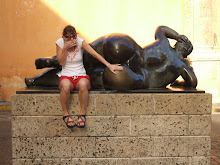
Besides, I shouldn't have started with the low-lights. My morning exploring Medellín reminded me of being in Mexico City because I was on a mission to see every piece of art by Fernando Botero, just like I was in Mexico City to see evertthing I could by Diego Rivera. I started the Plazoleta de las Esculturas, a plaza full of sculptures by Medellín's iconic native son, artist Fernando Botero. They are just kind of there -- with people bustling all around them, and they are lovely. Then I went into the Museo de Antioquia that's right on the plaza; again, full of Botero sculptures, paintings, and sketches. As if that weren't enough, then I trekked over to another plaza to see the sculptured I most wanted to check out: the dove. Botero made a big bronze sculpture of a peace dove I don't know when, but it was blown up in 1995 in an attack that killed over 20 people. He urged the city to leave the destroyed statue there as a symbol of the violence that continues to affect millions of Colombians everyday. So the warped and gaping sculpture is still in the same spot -- next to a new sculpture of a dove that Botero gave as a gift to the city.


I saw some other sights while I was in Medellín, but I think it would be boring if I just talked all about them here. So I will close with the observation that no blog entry is complete if I don't list a couple of cool or weird or unique things that I have seen in Colombia, in this case, in Medellín.

1. Orchids growing like any other tropical plant on the street near my hotel
2. Many men with mullets, including some pretty severe ones that featured really closely cut hair on top
3. In the botanical garden, a very heavily armed security guard (no big shocker there)... riding a bicycle in circles like he was a 10 year-old showing off to his friends but with a shotgun strapped across his chest.
4. Also in the botanical garden, a guy jogging while wearing a motorcycle helmet on his head

And finally, the best/worst response I've ever gotten upon asking an airline employee about the status of our plane (during a five hour delay): "It should be leaving at 12:30, God willing."