Tuesday, June 18, 2013

Sunday, March 31, 2013
Things I'm going to miss #4: Devotion
I had started to think about
this aspect of life in Colombia the other day when I saw a teenaged boy walking
down the street arm in arm with his mom (or aunt or grandma), but I didn’t know
what to call it until I walked past a church today, Easter Sunday. The church
of Santa Beatriz is between my apartment and the gym and the seamstress and the
hardware store and the closest mini-market, so I walk past it pretty often,
including most Sundays and holy days that we have off work. Without fail, when Mass is being celebrated
on those days, the place is so packed that people are standing in the doorways
or sitting outside in little camping chairs or on tiny folding wooden stools. Non-practicing-anything heathen that I am, I
always think that that seems like a lot of trouble to go to for Mass, but I
also always have to marvel at what moves people to do it. Today I saw this devotion taken to another
level. Not only were people standing in
the doorways, but they were doing so in crowds ten people deep. Others were sitting on the park benches outside the church next to the avocado seller
lady who is a fixture here at Santa Beatriz.
Even later, when the service was over, I noticed (not for the first
time) that many people who walked past the now-closed-up church crossed
themselves as they went by. I am not
saying that all Colombians line up for Mass (in fact, many are devoted to a wide
range of Protestant churches too), or that people in the States don’t turn out
in huge numbers at churches on Sunday, but something about the worshippers
camped out at Santa Beatriz gives me pause and reminds me of the fervor with
which Colombians approach so many aspects of their lives.
Take the family, for
example. Going back to the teenaged boy
walking arm in arm with his mom, I have to say that that’s not something that I
have seen very often in the States and to me, that gesture captures a simple
truth about life in Colombia, namely that family is everything. Having grown up far away from all but my
immediate family and having subsequently moved away from them too, I have to
appreciate the closeness that characterizes so many families here. From my friend Adelaida who spends pretty much
every Sunday at her parents’ house and whose sixteen year-old daughter is not above
coming to the faculty room to give her mom a hug, to María Elvira who rushes
home on her free afternoon to have lunch with her husband and either one of her
grown children if they’re around, to Camila who always seems to be doing one
thing or another with her mom, her dad, and/or her sister, to my Colombian
colleagues who are mystified by my decision to live so far away from my family,
to my student (she’s a senior) whose dad meets her and her brother at the
school bus stop most afternoons, to my manicure lady whose kids sometimes run
around the salon on a Saturday afternoon, family ties are everywhere and are
absolutely cherished.
 Indeed, it is safe to say that
the only thing that can even begin to compete with the treasures of faith and
family is the national soccer team. For
the first time in a long time, it has been kicking butt in the latest round of
World Cup qualifier matches (except for their 1-0 loss to Venezuela the other
day), and people are going nuts. On game
day you can buy a jersey on just about any street corner, and you kind of feel
like you need to unless you want to be the only schmuck in the city who isn’t wearing
one. Bars and restaurants are decorated
with balloons and streamers, and everybody from the ladies at the salon to the
patients in a doctor’s waiting room are glued to the TV. If for some reason you aren’t watching the
game, no worries. You can tell when
Colombia scores a goal by the shouts that reverberate through every apartment
building on the block. I can't wait til they play Argentina in June.
Indeed, it is safe to say that
the only thing that can even begin to compete with the treasures of faith and
family is the national soccer team. For
the first time in a long time, it has been kicking butt in the latest round of
World Cup qualifier matches (except for their 1-0 loss to Venezuela the other
day), and people are going nuts. On game
day you can buy a jersey on just about any street corner, and you kind of feel
like you need to unless you want to be the only schmuck in the city who isn’t wearing
one. Bars and restaurants are decorated
with balloons and streamers, and everybody from the ladies at the salon to the
patients in a doctor’s waiting room are glued to the TV. If for some reason you aren’t watching the
game, no worries. You can tell when
Colombia scores a goal by the shouts that reverberate through every apartment
building on the block. I can't wait til they play Argentina in June.Wednesday, March 27, 2013
Things I'm going to miss #3: The food
I know. No
surprise that I have a lot to say about this.
While I hope to be reincarnated as Anthony Bourdain so I can just roam planet
and eat, until then I have to take a little time to rave about the food in my current
corner of the world. As a rule, Andean
fare is pretty bland. My experiences in
Peru and Ecuador taught me that before I ever arrived in Colombia. Corn and potatoes feature prominently, which
can be, well, boring. But while potatoes
(especially) are everywhere here, there are about a hundred different types of
them, and they are – hands down – the most delicious potatoes you’ve ever
encountered. Seriously, you get yourself
some little tiny boiled and salted papas
criollas, and you will tell Idaho to just not even bother.
 Colombian cuisine, however, goes way beyond
potatoes. Take for example what is maybe
my favorite (and surely the most lethal) Colombian dish: bandeja paisa (paisa platter, i.e. platter from the department of
Antioquia – where Medellín is). This is
truly a heart attack on a plate, and much to my delight, the cafeteria at
Colegio Los Nogales does a more than respectable version of it. It is a delicious spread of rice, beans,
ground beef, fried plantain, a fried egg, and chicharrones, all garnished
with an avocado. Calling chicharrones pork rinds really doesn’t
begin to do them justice because it just makes them sound like those gross
things you buy in a bag at a gas station when, in fact, they are all meaty (ok,
and fatty) porky goodness. I can’t
believe it took me until this year to figure out that on bandeja paisa day it is best to go through the lunch line with
somebody who doesn’t do chicharrones
so you can have theirs. Gracias, David
Aguirre. Although teaching class after a
double helping of pork rinds may not equal stellar history instruction. Good thing the kids are as comatose as I
am.
Colombian cuisine, however, goes way beyond
potatoes. Take for example what is maybe
my favorite (and surely the most lethal) Colombian dish: bandeja paisa (paisa platter, i.e. platter from the department of
Antioquia – where Medellín is). This is
truly a heart attack on a plate, and much to my delight, the cafeteria at
Colegio Los Nogales does a more than respectable version of it. It is a delicious spread of rice, beans,
ground beef, fried plantain, a fried egg, and chicharrones, all garnished
with an avocado. Calling chicharrones pork rinds really doesn’t
begin to do them justice because it just makes them sound like those gross
things you buy in a bag at a gas station when, in fact, they are all meaty (ok,
and fatty) porky goodness. I can’t
believe it took me until this year to figure out that on bandeja paisa day it is best to go through the lunch line with
somebody who doesn’t do chicharrones
so you can have theirs. Gracias, David
Aguirre. Although teaching class after a
double helping of pork rinds may not equal stellar history instruction. Good thing the kids are as comatose as I
am.
The accompanying photographs show two of my other
all-time favorite Colombian delicacies.
First, ceviche (above & which I hope
you’ve tried somewhere) is just raw fish “cooked” in lime juice. I don’t know what else to say about it. I am fortunate to have a great cevichería around the corner, which I go
to very often. Yet as good as it is
there, I have actually figured out how to improve on their deliciousness and
get it up to the truly-very-special standards of La Cevichería in Cartagena:
mint and olive oil. And while I love
that you can find ceviche everywhere, I am not so sure it belongs
everywhere. The movie theater? I’ll stick to popcorn, thanks.
 And then there are tamales. If you’re like my mom when she visited Bogotá
a couple of years ago, prior to trying good tamales
tolimenses you thought that tamales were dried out corn meal stuffed in
dried out corn husks. But just as the
tamales I bought from a lady selling them out of a bucket in a market in Oaxaca
were nothing like the crap you can get most places in the States, these tamales
(wrapped in banana leaves) from Tolima are unlike anything you’ve ever
had. Trust me. I’m pretty sure that the floppy
semi-transparent things in them are just slabs of (chicken?) fat, but combined
with the smokiness imparted by the
banana leaves, these bundles of joy are truly memorable. Sí
señor, with some Colombian hot chocolate (minus the cheese that some people
melt into it – that’s one food thing I have not been able to get behind), I
could probably eat my own body weight in these little gems from Tolima. Fortunately for me and hung-over Colombians, they
are ubiquitous at Saturday and Sunday morning breakfast places. In my humble gringa opinion, some of the very
best ones (pictured here) are to be found at La Puerta Falsa, a tiny place off
the Plaza de Bolívar that has been open since 1816. As part of my Semana Santa stay-cation I
schlepped down there today just for the tamales. Even if it weren’t a block from one of my
favorite bookstores in Bogotá, it would have been worth the trip.
And then there are tamales. If you’re like my mom when she visited Bogotá
a couple of years ago, prior to trying good tamales
tolimenses you thought that tamales were dried out corn meal stuffed in
dried out corn husks. But just as the
tamales I bought from a lady selling them out of a bucket in a market in Oaxaca
were nothing like the crap you can get most places in the States, these tamales
(wrapped in banana leaves) from Tolima are unlike anything you’ve ever
had. Trust me. I’m pretty sure that the floppy
semi-transparent things in them are just slabs of (chicken?) fat, but combined
with the smokiness imparted by the
banana leaves, these bundles of joy are truly memorable. Sí
señor, with some Colombian hot chocolate (minus the cheese that some people
melt into it – that’s one food thing I have not been able to get behind), I
could probably eat my own body weight in these little gems from Tolima. Fortunately for me and hung-over Colombians, they
are ubiquitous at Saturday and Sunday morning breakfast places. In my humble gringa opinion, some of the very
best ones (pictured here) are to be found at La Puerta Falsa, a tiny place off
the Plaza de Bolívar that has been open since 1816. As part of my Semana Santa stay-cation I
schlepped down there today just for the tamales. Even if it weren’t a block from one of my
favorite bookstores in Bogotá, it would have been worth the trip.Monday, March 25, 2013
Things I'm going to miss #2: Nicknames, pet names, and terms of endearment
As someone who has never had a nickname (in English there’s not much you
can do with Sarah), I have loved that in Colombia I have, not one, but two of them. Like I have always been anywhere
in Latin America, here I am Sarita. But besides
“–ita” also Colombians have “-is” as another diminutive/term of endearment that
they add to the end of people’s names.
So here I am sometimes Saris, and I love it when people call me that
because a) it’s only for people you really like and b) it’s so 100% Colombian.
Those are some of the things you do with people’s names,
but there is also a whole host of other pet names and ways of addressing people
that Colombians use that I think are great.
There are some things that are reserved only for people you know really
well (like family) and others where the line is more blurry. I crack up whenever I hear my friends call
their husbands or children “gordo” or “gorda” (fatty), especially when they are
not at all. I also love it when people
refer to babies or toddlers as “mami” and “papi,” since they are clearly nobody’s
parents. Then there are some of the ways
I have been addressed in stores or at the gym or at the market or by people at
school. Among my favorites are: “mi vida”
(my life), “mi reina” (my queen), “mujer” (woman – I think this is more a thing
from the coast, but the guy at the photocopy place called me it yesterday), and
“profe” (short for profesora (teacher)).
There’s also the expression “sumercé,” which is short for “su merced”
(your mercy) and is a veeeery old fashioned but widely-used way of addressing
someone respectfully. I’ve always
thought it was surprising that the graffiti artists at the Universidad Nacional
use it in some of their calls to arms, though I guess it does rhyme with “rebelarse”
(to rebel), which is how it usually
appears.
Friday, March 22, 2013
Things I'm going to miss about Colombia #1
After getting off to a strong start almost four years
ago, this blog has been woefully neglected in recent times. Save for a trip to Cuba and a tear gas
incident at the Universidad Nacional, life in Bogotá became just
that: life. It was good, though not
necessarily remarkable or anything that felt blog-worthy. But now this gringa en Colombia is bringing
her time here to a close, and I am feeling a need to savor and document my last
few months.
On Facebook I have a photo album entitled “Things I’m
going to miss about Colombia,” and it brings me a little joy every time I add to it. So I think that this space needs to be where
I record things I’m going to miss for which there is no accompanying visual. Expect frequent updates.

Here begins the list (in no particular order).
1. The
public buses. This may seem an unexpected
listing because, really, these vehicles of questionable origin that hurtle down
Bogotá’s streets at sometimes terrifying speeds reflect the best and the worst
that Colombia has to offer. I am
choosing to focus on the former. Bogotá
bus culture and etiquette are surprising and refreshing in many ways. I mean, where else do they play salsa music
on public transportation to which passengers unabashedly sing along? And in what other country on the planet do
people hover/squat over a recently-occupied seat to let the butt heat dissipate
before sitting down? They even
have a saying for that: “Asiento caliente? Ni de pariente.” (Hot seat? Not even
of a relative). And for all the smack
that people from other parts of the country talk about “Rolos” (people from
Bogotá) and how cold and heartless they are, there is one bus practice that I
love and that I don’t think you would ever see in the United States, or many
other places for that matter. When the
buses are really packed and so passengers are even boarding through the back
door, these people who are barely squeezing on pass their fare forward via
other passengers who then pass back any necessary change. We are talking money changing hands about 50
times here. In a similar spirit of
solidarity, if a standing passenger has a big or heavy bag or package, then a
nearby seated passenger will usually offer to hold it on their lap. Oh, and also the buses get you where you
need to go for less than a dollar.
Thursday, March 29, 2012
La lucha sigue

EVERYBODY said this would happen.
I WAS SO EXCITED to begin my class on land, politics, and territory in Colombia and to get out of northern Bogotá bubble at least once a week! But when I told my Colombian friends, colleagues, and students that I was going to take a class at the Universidad Nacional, pretty much everybody scoffed that I was bound to miss at least a few classes because of protests at the notoriously radical university. Usually the remark was kind of snide and hinted at (at the very least) disdain for the leftist riff-raff that attends what is one of the most competitive universities in Colombia. Some people were more supportive. My friend and colleague Carlos, who appreciated the awesomeness of my photo with Subcomandante Marcos, laughed knowingly when I told him that my class was in the sociology department. He knew perfectly well that it wouldn't bother me a bit to hear that, in his words, "Oh, those guys are a bunch of communists." I figure that if the long history of shocking inequality and violence that have marked the land issue in Colombia doesn't get you fired up and make you want to bust our your Che Guevara T-shirt, then I really don't know what will.
ALL OF THAT TO SAY, what I saw this afternoon didn't come as a great shock to me. When I got off the TransMilenio (Bogotá's astoundingly irritating but sometimes convenient  trolley bus system) at the univeristy stop, it seemed like something was up. I mean, I don't have a lot of experience with gun shots, but the "pop! pop!" sounds I was hearing did not seem to bode well. Needless to say, I headed out of the station to see what was going on.
 trolley bus system) at the univeristy stop, it seemed like something was up. I mean, I don't have a lot of experience with gun shots, but the "pop! pop!" sounds I was hearing did not seem to bode well. Needless to say, I headed out of the station to see what was going on.
 THERE WERE HUNDREDS OF PEOPLE lining the several pedestrian overpasses that cross one of Bogotá's major thoroughfares ("la 30") near the entrance to the university. The were riot police at the entrance, on the median strip, across the street, and on some of the walkways. There was a very ominous-looking black armored car/tank thing parked in the gate of the school. It was clear that the shit was about to hit the fan.
AS LUCK WOULD HAVE IT, I had brought my camera so I could take pictures of the sometimes-over-the-top-but-very-compelling leftist graffiti that adorns the campus so I could include it in a blog post about my class. I'm no Christiane Amanpour or Nicholas Kristof, but you can be sure I was going to document this new, developing situation from my excellent perch on the overpass. By this time,  the police were shooting tear gas canisters from the median strip as the people around me shouted various obscenities at them. Some were shooting from closer to the university gates. Some came pounding up the stairs to take a position on the adjacent overpass to ours. Some were revving their motorcycles on the other side of the street. You could barely see the students inside, but every once in a while I caught a glimpse of people with their faces covered hurling rocks. You could smell the tear gas in the air, but it was kind of far away -- at least until one of the cops shot a tear gas canister and it hit the giant TransMilenio sign and bounced back across la 30 to his feet. Everybody booed and hissed and jeered at his lousy aim. But then everybody also figured out that the canister was way too close to us on this breezy afternoon. And boy, did the wind catch that smoke and send it our way. I've been to a lot of protests, but I've never had a dose of tear gas. It is terrible. With just a whiff, my eyes were watering like crazy, my throat was on fire, and I was coughing uncontrollably. I can't even begin to imagine what it would be like to really get a faceful of that stuff.
 the police were shooting tear gas canisters from the median strip as the people around me shouted various obscenities at them. Some were shooting from closer to the university gates. Some came pounding up the stairs to take a position on the adjacent overpass to ours. Some were revving their motorcycles on the other side of the street. You could barely see the students inside, but every once in a while I caught a glimpse of people with their faces covered hurling rocks. You could smell the tear gas in the air, but it was kind of far away -- at least until one of the cops shot a tear gas canister and it hit the giant TransMilenio sign and bounced back across la 30 to his feet. Everybody booed and hissed and jeered at his lousy aim. But then everybody also figured out that the canister was way too close to us on this breezy afternoon. And boy, did the wind catch that smoke and send it our way. I've been to a lot of protests, but I've never had a dose of tear gas. It is terrible. With just a whiff, my eyes were watering like crazy, my throat was on fire, and I was coughing uncontrollably. I can't even begin to imagine what it would be like to really get a faceful of that stuff.
 I THINK IT WAS AT ABOUT THIS POINT that I thought about how my parents and my principal would KILL me if they knew where I was. I hung around to get some more photos and videos but eventually figured I should probably get my gringa self the hell out of there. So, eyes stinging, I crammed myself into the mobile sardine can that is the TransMilenio at rushhour and headed back north to my bougie enclave.
SO WHAT WAS IT ALL ABOUT? As explained to me by the very nice, very pierced young man standing next to me, it had to do with the selection of the university's next rector. Apparently, the university went through some kind of voting or consultation process that allowed students, professor s, and alums to vote from among seven candidates. Lawyer and political scientist Leopoldo Múnera won by a giagntic margin, earning something like 75 or 80% of the vote. But today, when the Consejo Superior of the university announced the name of the new rector, it was . . . not Múnera. Instead, they installed Ignacio Mantilla, a mathematician and former dean of the faculty of sciences. Besides the fact that people were pissed about a supposedly democratic process being a farce, it's complicated by the fact that Mantilla is like the poster boy for increased involvement of the private sector (read: business) in public education in Colombia -- a new law about which had tens of thousands of people in the street last year protesting. I went to a couple of newspapers' websites to try to do a little fact-checking about this explanation, but all I found were really generic reports about Mantilla and his background. Given the political context in Colombia right now, in the absence of a better explanation, I'm going with the story as told to me by the university student with a stainless steel rod in his nose.
 s, and alums to vote from among seven candidates. Lawyer and political scientist Leopoldo Múnera won by a giagntic margin, earning something like 75 or 80% of the vote. But today, when the Consejo Superior of the university announced the name of the new rector, it was . . . not Múnera. Instead, they installed Ignacio Mantilla, a mathematician and former dean of the faculty of sciences. Besides the fact that people were pissed about a supposedly democratic process being a farce, it's complicated by the fact that Mantilla is like the poster boy for increased involvement of the private sector (read: business) in public education in Colombia -- a new law about which had tens of thousands of people in the street last year protesting. I went to a couple of newspapers' websites to try to do a little fact-checking about this explanation, but all I found were really generic reports about Mantilla and his background. Given the political context in Colombia right now, in the absence of a better explanation, I'm going with the story as told to me by the university student with a stainless steel rod in his nose.
Sunday, April 24, 2011
The Revolution will not be televised, but it has great rhythm
I arrived in Cuba on the afternoon of April 16, which was the 50th anniversary of the Bay of Pigs invasion, that U.S.-backed debacle that Cubans refer to as the battle of Playa Girón  (after one of the beaches where the attackers landed). For a history geek fascinated by the history of radical political movements and a long-standing interest in the history of U.S. intervention in Latin America, this was a great starting point. This island, so demonized by U.S. politicians for years, really had pulled off something different than any other country in the region. So what have been the impacts, dare I say the successes and failures, of this other American revolution? What does communism look like in practice? As a casual tourist, would I even be able to tell? Or would I have to "settle" for just soaking up the uniqueness of the things I had expected to see: old cars, crumbling but clearly once-grand buildings, impossibly turquoise Caribbean waters, and revolutionary propaganda everywhere?
 (after one of the beaches where the attackers landed). For a history geek fascinated by the history of radical political movements and a long-standing interest in the history of U.S. intervention in Latin America, this was a great starting point. This island, so demonized by U.S. politicians for years, really had pulled off something different than any other country in the region. So what have been the impacts, dare I say the successes and failures, of this other American revolution? What does communism look like in practice? As a casual tourist, would I even be able to tell? Or would I have to "settle" for just soaking up the uniqueness of the things I had expected to see: old cars, crumbling but clearly once-grand buildings, impossibly turquoise Caribbean waters, and revolutionary propaganda everywhere?
One of the first things that struck me as I walked around Havana was that the re were used book stalls all over the place. Of course, Fidel's writings featured prominently in the selection, as did books by and about Che Guevara and José Martí. Also ubiquitous were the newspapers of the Cuban Communist Party, Granma (named for the boat that carried Fidel, Che, and other revolutionaries to Cuba from Mexico in 1956) and Juventud Rebelde (Rebel Youth); people were selling them and reading them on every corner. Say what you will about what people were reading -- I bought a comic book called "Girón: Victory of the People" -- but the fact of the matter is that is a country of highly literate people. According to the CIA World Factbook, the literacy rate in Cuba is 99.8%. Not long after coming to power, the revolutionary government declared 1961 "The Year of Education." That year, "literacy brigades" fanned out across the country and taught more than 700,000 people to read and write. To me, this is a pretty amazing accomplishment.
That said, I had plenty of moments when stereotypically not-so-great things about communism were (sometimes comically) apparent. There was the fancy-looking ice cream parlor where it took a game of twenty questions to establish that they only had one flavor available. There was the customer service, which could be indifferent at best or even make you feel like you were out of line for interrupting the person who was reapplying their makeup, braiding a girl's hair, or having a snack. There was the airport waiting room that was almost pitch black because all the lights were burnt out. There were the Soviet-era airplanes. Sweet Jesus, those planes! Thankfully, I had been warned about the condensed, foggy air that came billowing out from under the seats prior to landing, but still.
And then there was the propaganda. It is absolutely everywhere you turn, in the form of murals, flags, banners, posters, billboards, handwritten signs, and (my personal favorite) coloring books. It is full of hyperbole and optimism. Sometimes it is an overt call to arms. It permeates captions under exhibits in museums. It maintains the cults of personality of (mainly) Fidel, Che, and Camilo Cienfuegos. It is without a trace of irony. Truthfully, to me, it was everything from quaint to ridiculous to cheesy to creepy to downright funny. I know it's not supposed to be any of those things, but I have to admit that that's how I saw it.
These casual observations aside, it was my conversations with regular people that gave me the best -- which is to say, complex -- picture of what the revolution meant for the average Cuban. Antonio, the tour guide who led me around on my first day there, showed me his card that gives him permission to "trabajar por cuenta propria" (work on his own behalf) and told me about his work with brigades doing extermination of mosquitos. I was struck by my encounter with a man who, upon seeing me taking a photo of a Girón commemoration poster, stopped rooting through the garbage to show me the pin that identifies him as a veteran of the battle. Jorge the Havana taxi driver talked about how gratifying his work as a teacher in Angola was, when he went there in what I can only think of as a sort of communist Peace Corps. The groundskeeper and father of two who showed me around the historic Colón cemetary told me about how his wife disappeared, only to call him from Miami to let him know she wasn't coming back. Manuel, a taxi driver in Santiago de Cuba, reflected on his time spent cutting sugar cane and gave a withering indictment of a system that he described as failed. His observations stood in stark contrast to those of my hosts in Santiago who raved about the Girón commemoration extravaganza televised a few days earlier and, while acknowledging that they weren't enough, boasted that the prices of certain rationed goods had not changed since 1970.
So I am left with those stories and images and impressions, as well as an appreciation for the music that comes from every corner, the spontaneous salsa dance party I saw on the beach, the sunshine, the mojitos, and the warmth that (despite my earlier observation about customer service) characterized my interactions with almost every Cuban I met.
 re were used book stalls all over the place. Of course, Fidel's writings featured prominently in the selection, as did books by and about Che Guevara and José Martí. Also ubiquitous were the newspapers of the Cuban Communist Party, Granma (named for the boat that carried Fidel, Che, and other revolutionaries to Cuba from Mexico in 1956) and Juventud Rebelde (Rebel Youth); people were selling them and reading them on every corner. Say what you will about what people were reading -- I bought a comic book called "Girón: Victory of the People" -- but the fact of the matter is that is a country of highly literate people. According to the CIA World Factbook, the literacy rate in Cuba is 99.8%. Not long after coming to power, the revolutionary government declared 1961 "The Year of Education." That year, "literacy brigades" fanned out across the country and taught more than 700,000 people to read and write. To me, this is a pretty amazing accomplishment.
That said, I had plenty of moments when stereotypically not-so-great things about communism were (sometimes comically) apparent. There was the fancy-looking ice cream parlor where it took a game of twenty questions to establish that they only had one flavor available. There was the customer service, which could be indifferent at best or even make you feel like you were out of line for interrupting the person who was reapplying their makeup, braiding a girl's hair, or having a snack. There was the airport waiting room that was almost pitch black because all the lights were burnt out. There were the Soviet-era airplanes. Sweet Jesus, those planes! Thankfully, I had been warned about the condensed, foggy air that came billowing out from under the seats prior to landing, but still.
And then there was the propaganda. It is absolutely everywhere you turn, in the form of murals, flags, banners, posters, billboards, handwritten signs, and (my personal favorite) coloring books. It is full of hyperbole and optimism. Sometimes it is an overt call to arms. It permeates captions under exhibits in museums. It maintains the cults of personality of (mainly) Fidel, Che, and Camilo Cienfuegos. It is without a trace of irony. Truthfully, to me, it was everything from quaint to ridiculous to cheesy to creepy to downright funny. I know it's not supposed to be any of those things, but I have to admit that that's how I saw it.
These casual observations aside, it was my conversations with regular people that gave me the best -- which is to say, complex -- picture of what the revolution meant for the average Cuban. Antonio, the tour guide who led me around on my first day there, showed me his card that gives him permission to "trabajar por cuenta propria" (work on his own behalf) and told me about his work with brigades doing extermination of mosquitos. I was struck by my encounter with a man who, upon seeing me taking a photo of a Girón commemoration poster, stopped rooting through the garbage to show me the pin that identifies him as a veteran of the battle. Jorge the Havana taxi driver talked about how gratifying his work as a teacher in Angola was, when he went there in what I can only think of as a sort of communist Peace Corps. The groundskeeper and father of two who showed me around the historic Colón cemetary told me about how his wife disappeared, only to call him from Miami to let him know she wasn't coming back. Manuel, a taxi driver in Santiago de Cuba, reflected on his time spent cutting sugar cane and gave a withering indictment of a system that he described as failed. His observations stood in stark contrast to those of my hosts in Santiago who raved about the Girón commemoration extravaganza televised a few days earlier and, while acknowledging that they weren't enough, boasted that the prices of certain rationed goods had not changed since 1970.
So I am left with those stories and images and impressions, as well as an appreciation for the music that comes from every corner, the spontaneous salsa dance party I saw on the beach, the sunshine, the mojitos, and the warmth that (despite my earlier observation about customer service) characterized my interactions with almost every Cuban I met.
Monday, August 16, 2010
Stories of displacement from my Witness for Peace delegation
A while ago I posted an entry about the context of the Witness for Peace delegation that I went on last month, but I am only now able to sit down and write about the delegation itself. There is so much to tell that I just haven't known where to start. So this piece is but a humble attempt to do justice to the people who shared harrowing stories with us and to help give you a picture of the realities in one corner of Colombia.
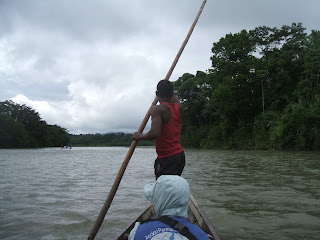
Over the course of four full days of travel in distant parts of the Curvaradó and Jig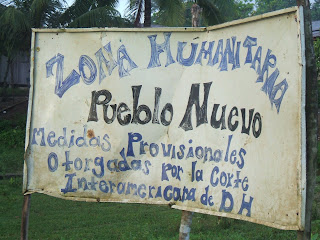 uamiendó river basins, our group visited five different communities. All but one were designated as "humanitarian zones," areas described well by an Inter Press Service article (see link below) as communities opposed to Colombia's ongoing war that "defend the distinction between civilians and combatants, as established by international humanitarian law." As one person in the Las Camelias humanitarian zone put it, the zone is "a way to protect our lives and our land in the midst of war." The zones all have the backing of the Inter-American Court of Human Rights.
 uamiendó river basins, our group visited five different communities. All but one were designated as "humanitarian zones," areas described well by an Inter Press Service article (see link below) as communities opposed to Colombia's ongoing war that "defend the distinction between civilians and combatants, as established by international humanitarian law." As one person in the Las Camelias humanitarian zone put it, the zone is "a way to protect our lives and our land in the midst of war." The zones all have the backing of the Inter-American Court of Human Rights.
The humanitarian zones are remote communities. To get to Pueblo Nuevo -- the first zone we visited -- we traveled by airplane, bus, 4x4, and boat (really a dugout canoe with  a motor attached to it). The zones have no electricity or running water. Residents practice some subsistence farming and barely eke out a living. In two of the zones I saw school buildings (more like shacks, really), but it was unclear to me if or when teachers actually come through to offer classes. In Pueblo Nuevo, as I stood under the leaky school roof while a torrential tropical rainstorm raged, I was hit by the smells of wood smoke and raw sewage. It occurred to me that that combination is the smell of poverty.
 a motor attached to it). The zones have no electricity or running water. Residents practice some subsistence farming and barely eke out a living. In two of the zones I saw school buildings (more like shacks, really), but it was unclear to me if or when teachers actually come through to offer classes. In Pueblo Nuevo, as I stood under the leaky school roof while a torrential tropical rainstorm raged, I was hit by the smells of wood smoke and raw sewage. It occurred to me that that combination is the smell of poverty.
The humanitarian zones were founded by peasant farmers who were forcibly displaced from their homes and their land by military and paramilitary operations in the mid- to late 1990s. They joined the ranks of Colombia's internally displaced population, which in 2009 (according to the Internal Displacement Monitoring cntre) numbered up to 4.9 million.
In Las Camelias, one woman (I'll call her Rosa) told a representative story of what displacement had entailed for her. Rosa is a rail-thin Afro-Colombian woman who smoked ragged cigarettes and hugged me like an old friend when she met me. She is the mother of eight, grandmother of 36, and great-grandmother of three. She has been accused of being a leader of the 57th Front of the guerrilla Revolutionary Armed Forces of Colombia. There is a reward on her head.
Her diplacement began in 1996, when she and some other people from her town fled into the jungle to escape armed attacks on their community. They lived there for six months. During that time, the men would sneak back to their land to get food. The group would scatter to another area whenever they heard gunshots. With help from a Spanish non-profit and an area church, Rosa and her companions eventually left the jungle for a town where they lived for a year -- all the while hearing gunshots and explosions as the paramilitaries occupied neighboring communities.
They then relocated to the town of Caño Seco where they could hear the destruction of the town from which they had just been displaced. While in Caño Seco, the community got together and decided that the elderly and people with young children should move to the town of Murindó. The rest of the group moved too, but to the town of Bartólo where they stayed for two years. This pattern continued for years. Rosa told us that, all totalled, the community endured 13 displacements before deciding to return to the land that had been theirs and establishing the humanitarian zone.

Heartrending stories like this one were repeated everywhere we went. It was hard to listen to over and over again. But it was impossible not to be intensely moved by the courage these people have shown and continue to show as they defend their right to live what in Spanish is called a "vida digna," a dignified life.
Stories of current struggles from my Witness for Peace delegation
Just as we heard many stories about forced displacement, we heard many accounts of current struggles in the humanitarian zones, all of whom are under violent pressure from the paramilitary-backed large land holders who took over the lands from which the communities were displaced.
The most extreme and most intense testimony we heard was in a tiny, recently-established humanitarian zone named for its leader who was assassinated in January of this year by two local known paramilitary agents who operate openly and with impunity. The wheels of justice turn excruciatingly slowly in Colombia, however, and the case has not moved forward. Now his brother who I'll call Javier, a soft-spoken man who spoke with downcast eyes, has received threats that he will end up like his brother if he does not stop his efforts to reclaim the community's land. He is afraid to leave the zone. His sister Elena wept as she talked about her fear for his safety, and person after person expressed the same concern.
The community has asked the police to patrol the perimeter of the zone to ensure its residents' safety, but this protection has yet to materialize. They do not want the army to be responsible for these patrols because they know that there are members of the paramilities working within that institution. After our meeting and lunch with the community, I chatted with a woman while she washed dishes. She illustrated why the community might need the protection of the police, she said she is afraid that the paramilitaries -- working in the service of neighboring land-holders -- will eventually just invade the zone some night while the community sleeps.
After describing their current fears, the community members spoke movingly about their life before their forced eviction by the army and paramilitaries. "We used to live well," said one woman. Elena told us that "Life was easier before. We had daily food . . . and were able to go to [the nearby town of] Mutatá to study. . . . But happiness doesn't last . . . I had to leave everything I loved." After hearing testimony like this, it was hard to leave this particular zone knowing that sometimes, an international presence can discourage paramilitary attacks.
But we had to get to a meeting with an official of the 17th brigade of the Colombian army, the military unit charged with providing security in the region we had visited (and the brigade that the communities had charged works hand-in-hand with paramilitary organizations). In a frigid, air-conditioned, and windowless meeting room, we spoke with a lieutenant who serves as the brigade's human rights officer. His answers to our carefully-constructed questions were at times telling and at times laughable. He explained that the primary factor that demonstrates improved security in the region is increased foreign and national investment. "The [civilian] population is not at risk today. This is proven by foreign investment," he said. Needless to say this comment belies the government's priority for the region and, in light of all we had heard in the humanitarian zones, begs the question "security for whom"? He went on: "The facts speak for themselves. There have been no violent deaths in the region and no attacks on civilians in this region." When asked about links between the army and paramilitary groups, he said that if they had existed, it was in the distant past. We left that meeting dismayed and more convinced than ever of the army's (and therefore the government's) total lack of concern for marginalized people like those who live in the humanitarian zones we had visited.
In light of all that we had seen an heard during our days in these rural parts of the Lower Atrato region I felt that there is little reason for optimism regarding the achievement of a real and sustainable peace in Colombia, the government's claims to the contrary notwithstanding. I had suspected as much even before my visit to the region. When I think back to my original reasons for going on this delegation, I can say that I accomplished what I had hoped to. I travelled far from the bubble of Bogotá. I saw the grinding poverty in which so many Colombians live. I got to be a witness to the realities of people affected by Colombia's enduring armed conflict. I was deeply moved and with a sense of responsibility to bear witness to these realities.
Friday, July 16, 2010
A little context about my delegation
Ten years after helping to start the Witness for Peace program in Colombia, I finally got to take part in a delegation here. It ended on Wednesday, and since then I have been struggling to figure out how to share what I learned in a way that isn’t too long, makes sense, and does justice to the people who entrusted their stories to us.
Our delegation focused on developments in the Urabá region of northwestern Colombia (near the border with Panamá). Rich in agricultural resources, biodiversity, and subsoil mineral wealth, the region is largely populated by Colombians of African descent. Most of the region is rural. Most importantly for our trip, Urabá has come to be seen as a microcosm of key problems facing Colombia. Here the issues of economic development, land ownership, internal displacement, paramilitary violence, and government inaction converge to devastating effect and in a pattern that is repeated all over the country.
But before I begin to tell the stories we heard during five days in the countryside, it is essential to give some context and background about Colombia today. So here are some things you should know.
· Since 2000, under an initiative called Plan Colombia, the United States has given about $7.3 billion in mostly military aid to Colombia. The main purpose of this aid is to fight the drug war, in which pretty much all of the armed actors in Colombia’s decades-long civil war are involved.
· Between 1999 and 2008, despite extensive aerial fumigation, the tonnage of cocaine produced in Colombia only dropped from 680 to 600. Coca is now cultivated in 20 of Colombia’s 32 departments.
· Since 2000, according to Witness for Peace, approximately 30,000 civilians have been killed, and 3 million have been displaced. The Colombian Ministry of Defense estimates that there have been 21,000 combat deaths since 2002.
· Using US assistance, outgoing Colombian president Alvaro Uribe implemented what he referred to as his “Democratic Security” policy. This involved a tripling of the military budget and nearly doubling the size of the security forces.
· During the time of Uribe’s Democratic Security policy, foreign investment (especially in extractive industries) has more than tripled, but rates of poverty and extreme poverty have barely budged.
· Between 2002 and 2008, Colombia was one of only three countries in Latin America where economic inequality increased.
· In the rural areas of Colombia, where approximately 25% of the country’s population lives, 0.4% of landholders control approximately 61.2% of the land.
· An estimated 80% of Colombia’s rural population lives in poverty.
So it was against this backdrop that my fellow delegates and I headed to Urabá to visit a number of "humanitarian zones," small communities where people displaced by violence that peaked in the 1990s have returned to or near the lands from which they were expelled. Now they are under tremendous pressure – and, at times, threat of death – from large landowners and cattle ranchers who, working hand in hand with paramilitaries and sometimes with the Colombian military, appropriated the abandoned lands to grow cash crops and raise cattle and who now claim to be the rightful owners of the land. It is an extremely complicated conflict and one that we worked hard to make sense out of. It was the people’s stories that helped us understand.
Our delegation focused on developments in the Urabá region of northwestern Colombia (near the border with Panamá). Rich in agricultural resources, biodiversity, and subsoil mineral wealth, the region is largely populated by Colombians of African descent. Most of the region is rural. Most importantly for our trip, Urabá has come to be seen as a microcosm of key problems facing Colombia. Here the issues of economic development, land ownership, internal displacement, paramilitary violence, and government inaction converge to devastating effect and in a pattern that is repeated all over the country.
But before I begin to tell the stories we heard during five days in the countryside, it is essential to give some context and background about Colombia today. So here are some things you should know.
· Since 2000, under an initiative called Plan Colombia, the United States has given about $7.3 billion in mostly military aid to Colombia. The main purpose of this aid is to fight the drug war, in which pretty much all of the armed actors in Colombia’s decades-long civil war are involved.
· Between 1999 and 2008, despite extensive aerial fumigation, the tonnage of cocaine produced in Colombia only dropped from 680 to 600. Coca is now cultivated in 20 of Colombia’s 32 departments.
· Since 2000, according to Witness for Peace, approximately 30,000 civilians have been killed, and 3 million have been displaced. The Colombian Ministry of Defense estimates that there have been 21,000 combat deaths since 2002.
· Using US assistance, outgoing Colombian president Alvaro Uribe implemented what he referred to as his “Democratic Security” policy. This involved a tripling of the military budget and nearly doubling the size of the security forces.
· During the time of Uribe’s Democratic Security policy, foreign investment (especially in extractive industries) has more than tripled, but rates of poverty and extreme poverty have barely budged.
· Between 2002 and 2008, Colombia was one of only three countries in Latin America where economic inequality increased.
· In the rural areas of Colombia, where approximately 25% of the country’s population lives, 0.4% of landholders control approximately 61.2% of the land.
· An estimated 80% of Colombia’s rural population lives in poverty.
So it was against this backdrop that my fellow delegates and I headed to Urabá to visit a number of "humanitarian zones," small communities where people displaced by violence that peaked in the 1990s have returned to or near the lands from which they were expelled. Now they are under tremendous pressure – and, at times, threat of death – from large landowners and cattle ranchers who, working hand in hand with paramilitaries and sometimes with the Colombian military, appropriated the abandoned lands to grow cash crops and raise cattle and who now claim to be the rightful owners of the land. It is an extremely complicated conflict and one that we worked hard to make sense out of. It was the people’s stories that helped us understand.
Thursday, July 1, 2010
Year one of teaching abroad: check.
The school year is over. It is almost impossible to believe, and as trite as it may sound, the time flew. I taught four different courses and coordinated (or tried to) a department of 12 people. I am so tired!
A lot of people have asked me how my first year was, and my answer is always: challenging. I think that sounds a little unoriginal, but it is the truth. I think it suggests something that is really hard but good. I worked my butt off this year. I went to school early --arriving at 6:00 or 6:30 a.m. -- many, many days. I went to a zillion meetings, wrote a zillion e-mails, and went to some lengthy workshops all in Spanish. There were days the language thing wore me out. There were days the kids drove me insane. There were days the grown-ups drove me insane. But the reason I say the year was challenging is that at no point did I wish I hadn't come here to do this. I am exhausted but so glad I made this move.
I think over the next month -- in the rare quiet moments I will have -- I will keep reflecting on the year. (I've kind of already started to do that as the year wound down). Not surprisingly, there are hundreds of things I want to do differently and other things that I hope I have really learned how to do. Next year will bring new challenges, like two new teachers in my department. But I am hopeful that I will generally have a better handle on things.
So now I am taking a few days to wind down, which is an extra nice thing to do in my new apartment, before my summer activities begin. First my Witness for Peace delegation, then flying around to Ohio and Boston, and finally off to California for an AP World History seminar at Stanford. Does that schedule mean I love a challenge?
A lot of people have asked me how my first year was, and my answer is always: challenging. I think that sounds a little unoriginal, but it is the truth. I think it suggests something that is really hard but good. I worked my butt off this year. I went to school early --arriving at 6:00 or 6:30 a.m. -- many, many days. I went to a zillion meetings, wrote a zillion e-mails, and went to some lengthy workshops all in Spanish. There were days the language thing wore me out. There were days the kids drove me insane. There were days the grown-ups drove me insane. But the reason I say the year was challenging is that at no point did I wish I hadn't come here to do this. I am exhausted but so glad I made this move.
I think over the next month -- in the rare quiet moments I will have -- I will keep reflecting on the year. (I've kind of already started to do that as the year wound down). Not surprisingly, there are hundreds of things I want to do differently and other things that I hope I have really learned how to do. Next year will bring new challenges, like two new teachers in my department. But I am hopeful that I will generally have a better handle on things.
So now I am taking a few days to wind down, which is an extra nice thing to do in my new apartment, before my summer activities begin. First my Witness for Peace delegation, then flying around to Ohio and Boston, and finally off to California for an AP World History seminar at Stanford. Does that schedule mean I love a challenge?
Thursday, April 15, 2010
Semana Santa
You know that great feeling when you step off a plane in a warm place and the sun is shining and the air is soft? That was how it felt to arrive in Popayán when I traveled there a couple of weeks ago to see the town’s famous Holy Week celebrations.
The reason we chose Popayán as our destination is that it is famous all over Colombia for its Holy Week celebrations, specifically the nightly processions featuring huge float-like things called pasos that are topped with statues of Jesus (many of them pretty gory), Mary, various saints, and other Biblical characters. These things weigh hundreds of kilos and are carried on the shoulders of the faithful, specifically men and boys for whom this privilege has been passed down through generations.
Probably the most interesting thing about witnessing these observances was that we got to see them several nights in a row, with each night having its own tone and mood. On the night of Holy Thursday, the statues depicted various scenes from events leading up to the crucifixion of Jesus (like his sentencing before Pilate and his being crowned with thorns), and the mood was pretty somber. (Not that there weren’t peanut and cotton candy vendors doing a booming business). On the night of Good Friday, the mood was even darker as the pasos told the story of the crucifixion. The people carrying them were dressed in purple, which was the color of all the flowers too. But on Saturday night, in anticipation of the resurrection, things turned joyful. The paso bearers wore white, and people applauded when the paso with the statue of Jesus resurrected came out. Interesting note: the resurrected Jesus was totally jacked – in stark contrast to the emaciated crucified Jesuses we had seen on previous nights. But whatever the condition of the Jesus statues, it was really a spectacle, quite unlike anything I’ve seen before.
Of course, it wouldn’t be Colombia without a pretty martial element. The National Police band was front and center, complete with kids who were some kind of scouts but just looked like mini-me policemen. Even more striking was the presence of the military. They appeared a couple of times in the procession (one group of them heavily armed), and we just couldn’t quite figure out how they fit in with the rolling orchestras (a woman playing a piano on wheels being pushed down the street – awesome) and altar boys. Nonetheless, it was cool to see the devotion and pageantry, even just as curious onlookers.
I was with my dear, dear friends Fiona and Sam who were visiting from London. Fio na, it bears mentioning, is kind of my only childhood friend. Growing up overseas means that even if you actually stay put in a country for a while, other people inevitably come and go. Fortunately for us, both Fiona’s and my families stayed in Rome for a long time – hence our friendship that dates back to when I was eight and she was ten. I think my at-home manicurist-pedicurist Sandra (who got us all fixed up before we headed to where the weather was sandal-worthy) put it best: she said we are “super amigas.” All of that to say, it was very special to have Fi and her husband Sam here and so great to get to travel with them.
 na, it bears mentioning, is kind of my only childhood friend. Growing up overseas means that even if you actually stay put in a country for a while, other people inevitably come and go. Fortunately for us, both Fiona’s and my families stayed in Rome for a long time – hence our friendship that dates back to when I was eight and she was ten. I think my at-home manicurist-pedicurist Sandra (who got us all fixed up before we headed to where the weather was sandal-worthy) put it best: she said we are “super amigas.” All of that to say, it was very special to have Fi and her husband Sam here and so great to get to travel with them.
 The reason we chose Popayán as our destination is that it is famous all over Colombia for its Holy Week celebrations, specifically the nightly processions featuring huge float-like things called pasos that are topped with statues of Jesus (many of them pretty gory), Mary, various saints, and other Biblical characters. These things weigh hundreds of kilos and are carried on the shoulders of the faithful, specifically men and boys for whom this privilege has been passed down through generations.
Probably the most interesting thing about witnessing these observances was that we got to see them several nights in a row, with each night having its own tone and mood. On the night of Holy Thursday, the statues depicted various scenes from events leading up to the crucifixion of Jesus (like his sentencing before Pilate and his being crowned with thorns), and the mood
 was pretty somber. (Not that there weren’t peanut and cotton candy vendors doing a booming business). On the night of Good Friday, the mood was even darker as the pasos told the story of the crucifixion. The people carrying them were dressed in purple, which was the color of all the flowers too. But on Saturday night, in anticipation of the resurrection, things turned joyful. The paso bearers wore white, and people applauded when the paso with the statue of Jesus resurrected came out. Interesting note: the resurrected Jesus was totally jacked – in stark contrast to the emaciated crucified Jesuses we had seen on previous nights. But whatever the condition of the Jesus statues, it was really a spectacle, quite unlike anything I’ve seen before.
Of course, it wouldn’t be Colombia without a pretty martial element. The National Police band was front and center, complete with kids who were some kind of scouts but just looked like mini-me policemen. Even more striking was the presence of the military. They appeared a couple of times in the procession (one group of them heavily armed), and we just couldn’t quite figure out how they fit in with the rolling orchestras (a woman playing a piano on wheels being pushed down the street – awesome) and altar boys. Nonetheless, it was cool to see the devotion and pageantry, even just as curious onlookers.
Tuesday, March 16, 2010
Election days
I know I am up too early when I hear the Colombian national anthem on my way to school. They play it on the radio at 6:00 every morning. I have come to associate it with sunrise. I think it's interesting to see how the national anthem is used or viewed in different countries. I feel like you don't hear it as much in the States, but I remember it being played before the start of the film in movie theatres in Thailand, complete with a gigantic image of the king projected on the screen.
I guess I am thinking about this public patriotism partly because of the elections that took place here on Sunday. [Disclaimer: I was a less than casual observer to them. I really barely followed them at all, so anything I write is based on the most general of impressions.] The elections were to choose members of the senate, and it seemed like there were a whole lot of parties to choose from. Walls were absolutely plastered with posters, and people in party T-shirts tried to give me literature about a hundred times in the past few weeks. Somehow one was more aware that something was going on than you might be in the U.S. First of all, during elections here the government imposes a ley seca or dry law. You couldn't by alcohol starting at 6 p.m. on Friday and until 6 a.m. on Monday. (I couldn't help but wonder who were the people lined up outside a liquor store at 6:01 Monday morning).
barely followed them at all, so anything I write is based on the most general of impressions.] The elections were to choose members of the senate, and it seemed like there were a whole lot of parties to choose from. Walls were absolutely plastered with posters, and people in party T-shirts tried to give me literature about a hundred times in the past few weeks. Somehow one was more aware that something was going on than you might be in the U.S. First of all, during elections here the government imposes a ley seca or dry law. You couldn't by alcohol starting at 6 p.m. on Friday and until 6 a.m. on Monday. (I couldn't help but wonder who were the people lined up outside a liquor store at 6:01 Monday morning).Second of all, starting on Thursday or Friday, security was beefed up everywhere. For instance, there is always a security guard at my supermarket around the corner, but on Thursday night he was carrying a massive shotgun. By Friday, the military and police were out in force, standing guard everywhere it seemed. The security guard at my building also told me that all the army and police were acuartelados for the whole weekend, meaning that no leaves were granted, and they had to be on call at all times. By Sunday, there were helicopters flying over my building what seemed like every few minutes. Frankly, I found it all a little intimidating, which I feel like would not be a good feeling to have as you go to vote. Or maybe in a country of so much conflict, it makes people feel safe. I wonder.
On election day itself things were buzzing. I happened to be at two different shopping centers that were being used as polling stations, and they were mobbed. And the police were out in force managing the crowds. Traffic was as bad as a week night rush hour, and the party faithful had fanned out everywhere. One supermarket was even running an election day lunch special. It was all pretty interesting to just observe, to see what was different from election days in the States. Now my question is: what is it going to be like when the presidential elections roll around in August?
Saturday, February 6, 2010
Remembering where I am

In the months that I've been here in Colombia, I have been a little frustrated by how insular I feel like my existence has been. The reality is that I spend most of my time at school and work a LOT at home. Many of my friends live on the northern side of Bogotá, where I do. We mostly go out to places on this side of town. So, getting out of my convenient comfort zone means making a deliberate point to take the time to get out and explore different parts of the city.

A couple of my friends and I did that last weekend. Even though it may sound funny since we actually live here, we went on an organized bike tour of Bogotá. It was great. It was the most perfect, sunny day, and we started down in La Candelaria, the lovely old colonial center of town. We wound our way through the colonial and government buildings, in and around a n umber of parks (at least one of which was made way for by razing a crime-ridden neighborhood, of course) and through bustling neighborhoods I had never been to or heard of. We made a stop at the central market, called Paloquemao, where I had one of the best arepas I've ever eaten and where we snacked on tropical fruits ranging from mangosteens (my favorite), to pitaya, to passion fruit. It made me so envious of my friend Moira, who gets to do her fruit and vegetable shopping there. From the market we continued on to the Central Cemetary, which is just as segregated by social class as any other one I have ever visited in Latin America. Next door was a series of crypts that had been emptied in preparation for demolition, but not before they were painted with silhouettes of bodies
 being carried on stretchers -- representing the dead of Colombia's armed conflict. We wound down our trip with a stop at the National Park before heading down the Ciclovía (the route of streets that are closed on Sundays to make way for bikers and pedestrians) back to La Candelaria. It was a perfect way and a perfect day to see other parts of the city. Turns out that it was also the perfect day to get the kind of sunburn you can only get by forgetting to wear sunscreen at 8500 feet.
 umber of parks (at least one of which was made way for by razing a crime-ridden neighborhood, of course) and through bustling neighborhoods I had never been to or heard of. We made a stop at the central market, called Paloquemao, where I had one of the best arepas I've ever eaten and where we snacked on tropical fruits ranging from mangosteens (my favorite), to pitaya, to passion fruit. It made me so envious of my friend Moira, who gets to do her fruit and vegetable shopping there. From the market we continued on to the Central Cemetary, which is just as segregated by social class as any other one I have ever visited in Latin America. Next door was a series of crypts that had been emptied in preparation for demolition, but not before they were painted with silhouettes of bodies
 being carried on stretchers -- representing the dead of Colombia's armed conflict. We wound down our trip with a stop at the National Park before heading down the Ciclovía (the route of streets that are closed on Sundays to make way for bikers and pedestrians) back to La Candelaria. It was a perfect way and a perfect day to see other parts of the city. Turns out that it was also the perfect day to get the kind of sunburn you can only get by forgetting to wear sunscreen at 8500 feet.
 My tour around Bogotá got me thinking about my insulation on a bigger scale. I think it was partly a question of timing. In the couple of days following that bike ride, I read about a new Human Rights Watch report about the successor groups of the paramilitaries here who continue to commit atrocities, got an update from a friend attending the trial of 10 army officers for complicity with paramilitaries in a massacre in a peace community a few years ago, and met three members of the U'wa indigenous group who are engaged in a struggle with the oil company Ecopetrol to prevent oil drilling on their native land. This is the country where I live, and I have been woefully uninformed about events here.

So I've made a belated New Year's resolution to commit myself to learning more about Colombia's history and to staying much better informed about what is going on here today. It's fine that I got a book on Colombian history recommeded to me by the woman in my department who teaches that class at school, but I know better than anyone the best way to get a first-hand crash course in the reality of any country in Latin America: go on a Witness for Peace delegation. I am so incredibly excited since I have decided to join (OK, I have to apply, but I am hoping that as a former staffer I will be accepted) a group in July that will travel to the Urabá region to learn about the situation facing people living in so-called humanitarian zones. According to the description on the Witness for Peace web site, "A humanitarian zone is a living area of a few acres surrounded by a barbed wire fence. The community puts signs on the fence proclaiming that this is a civilian zone, and nobody with a weapon is allowed inside. Because threats [from paramilitaries and the army trying to take over their land] continue, these communities rely on international attention for their survival."
I know I have a lot to learn, but I feel good for having committed myself to taking active steps to really remember where I am.
(To see some of the testimonials from the Human Rights Watch report, you can follow this link: http://www.hrw.org/en/feature/colombia-deadly_threat)
Monday, January 25, 2010
Bogotá birthday
So I am 35 now. As my friend Michael (who also just turned 35) pointed out, I am now halfway to 70. Thanks, Michael.
My shock at my old age notwithstanding, I was excited to mark my birthday, to mark a year of big changes and fresh starts, in the city I now call home. I figured that I would just do something small with a few Bogotá friends, new and old. What I couldn't have expected, what was the best surprise, was that I would be visited by the ghost of birthday past.
Many, many years ago, my family moved from Rome ("The Eternal City") to Findlay, Ohio ("Flag City, U.S.A."). I think most of you reading this have heard the story, so I'm not going to go into all the heinous details. What you may not have heard in the telling, however, is that there were people I met in Findlay who were a breath of fresh air during that dark period of my late adolesence. One of them was a guy named Andrew Evans. I met Andrew at the beginning of my senior year because he had spent our junior year as an exchange student in France. It's fair to say that we were kindred get-me-the-hell-out-of-this-town spirits from the start. That being the case, it is perfect that we would see each other for the first time in 17 years here, in Bogotá, on my 35th birthday.
[Insert plug for how cool Andrew is here: Andrew was in Bogotá because he is working on a project for National Geographic, namely traveling the length of the Americas by bus (and boat where necessary) in order to catch a boat to Antarctica in February and blogging/tweeting as he goes. His blog is insightful and funny, and I highly recommend it anyone who can only afford a vicarious trip to the South Pole. http://blogs.nationalgeographic.com/blogs/intelligenttravel/bus2antarctica/]
Intrepid traveler that he is, Andrew found his way to Andrés Carne de Res, Bogotá's world-famous, one and only freak show/steak house. This place really does defy description. The décor can best be described as Latin American religious kitsch-meets-Frida Kahlo's nightmare. There is weird stuff on the walls. The art work and logos are trippy, and sometimes the waiters and waitresses dress up in costumes. And afterwards there's a dance party. It should be pretty clear why I wanted to celebrate here.
Though things did get a little silly when one of the waiters in some kind of get-up brought me a plastic cake and made me dance (see attached video), the night was actually pretty tame. Andrew dispensed travel advice to my friend who's planning a trip to southern Africa; my friends dispensed travel advice to Andrew who is traveling by bus through a country that is at war. I drank too many too strong mojitos, reveled in the good company, and just felt lucky to have great friends, no matter how old I am.
My shock at my old age notwithstanding, I was excited to mark my birthday, to mark a year of big changes and fresh starts, in the city I now call home. I figured that I would just do something small with a few Bogotá friends, new and old. What I couldn't have expected, what was the best surprise, was that I would be visited by the ghost of birthday past.
Many, many years ago, my family moved from Rome ("The Eternal City") to Findlay, Ohio ("Flag City, U.S.A."). I think most of you reading this have heard the story, so I'm not going to go into all the heinous details. What you may not have heard in the telling, however, is that there were people I met in Findlay who were a breath of fresh air during that dark period of my late adolesence. One of them was a guy named Andrew Evans. I met Andrew at the beginning of my senior year because he had spent our junior year as an exchange student in France. It's fair to say that we were kindred get-me-the-hell-out-of-this-town spirits from the start. That being the case, it is perfect that we would see each other for the first time in 17 years here, in Bogotá, on my 35th birthday.
[Insert plug for how cool Andrew is here: Andrew was in Bogotá because he is working on a project for National Geographic, namely traveling the length of the Americas by bus (and boat where necessary) in order to catch a boat to Antarctica in February and blogging/tweeting as he goes. His blog is insightful and funny, and I highly recommend it anyone who can only afford a vicarious trip to the South Pole. http://blogs.nationalgeographic.com/blogs/intelligenttravel/bus2antarctica/]
Intrepid traveler that he is, Andrew found his way to Andrés Carne de Res, Bogotá's world-famous, one and only freak show/steak house. This place really does defy description. The décor can best be described as Latin American religious kitsch-meets-Frida Kahlo's nightmare. There is weird stuff on the walls. The art work and logos are trippy, and sometimes the waiters and waitresses dress up in costumes. And afterwards there's a dance party. It should be pretty clear why I wanted to celebrate here.
Though things did get a little silly when one of the waiters in some kind of get-up brought me a plastic cake and made me dance (see attached video), the night was actually pretty tame. Andrew dispensed travel advice to my friend who's planning a trip to southern Africa; my friends dispensed travel advice to Andrew who is traveling by bus through a country that is at war. I drank too many too strong mojitos, reveled in the good company, and just felt lucky to have great friends, no matter how old I am.
Saturday, December 19, 2009
More from the Amazon
I have to write more about our days in Puerto Nariño, the jumping-off point for our jungle adventures. Forgive me the length of this post. It's just that there is so much to tell.
The first day we went on a boat trip to Lake Tarapoto, home of the famous pink dolphins. We only saw a couple that were kind of purple but to cruise down the Amazon in a little motor boat was incredible. We stopped in an indigenous village and later went for a swim in the river's very murky waters. I was sure something was going to attack us, but we emerged unscathed by either pirañas or any other scary critter.
The next day was our first big hike, this one to a different indigenous community called San Martín. It was a three-hour trek through the most mosquito-infested place I have ever been. They positively swarmed around us. On an otherwise tranquil hike, we did have a slightly nerve-wracking moment when we unexpectedly hit the end of the trail -- not where we were supposed to or where the boat was supposed to meet us. Fortunately, we came across a local Ticuna man, his hands and face painted a dark blue color from a plant dye used by indigenous people in the area, with a dugout canoe who ferried us across a stream so we could continue our trek. When we finally made it to San Martín we were greeted by, among other curious onlookers, by a toddler yelling "Turistas!" as we passed. It was hilarious yet disturbing at the same time. The kind of surreal experience continued as the local drunk insisted on being our tour guide through the community. Finally -- when, I swear, I didn't think I could walk another step in the rubber boots we had to wear for this muddy hike -- we headed back to Puerto Nariño by boat.
Our last full day in Puerto Nariño we went on a much more hard-core, much more jungly hike. We tromped through mud and grasses taller than us. We ate wild grapes and tasted some local yucca moonshine-like drink (not particulalry tasty). We walked through several communities (one complete with soccer field and covered bridges) in the middle of nowhere. Again, the silly-looking and spectacularly uncomfortable rubber boots proved to be the best $7.50 I've spent in a while. It was worth every step in them, following our guide Saúl who cleared the path with his machete when necessary and taking in the green that surrounded us and the blue sky when we could see it.
Now we are back in Leticia, winding down our trip -- but not before we go to Peru for a ceviche lunch. Last night's stay in the indigenous community didn't happen because it was actually REALLY expensive. So instead, we walked across the border to Brazil to try some Brazilian beer (far superior to Colombia's most popular brand, Aguila) and to buy some Hawaiana (i.e. kind of trendy (?) and over-priced in the States) flip flops and $3.50 cahaça. I see homemade caipirinhas in our future.
In sum, if you ever have a chance to come to this sweltering part of the world -- home to skies that seem bigger than in other places, even when the daily rain clouds roll in, as well as to this enormous river that cuts through a dense jungle populated by isolated communities of indigenous people trying to both preserve and share their customs and traditions -- take it. You will feel as lucky as I do to have been so far from the rest of the world and seen such wonderfully different things.
The first day we went on a boat trip to Lake Tarapoto, home of the famous pink dolphins. We only saw a couple that were kind of purple but to cruise down the Amazon in a little motor boat was incredible. We stopped in an indigenous village and later went for a swim in the river's very murky waters. I was sure something was going to attack us, but we emerged unscathed by either pirañas or any other scary critter.
The next day was our first big hike, this one to a different indigenous community called San Martín. It was a three-hour trek through the most mosquito-infested place I have ever been. They positively swarmed around us. On an otherwise tranquil hike, we did have a slightly nerve-wracking moment when we unexpectedly hit the end of the trail -- not where we were supposed to or where the boat was supposed to meet us. Fortunately, we came across a local Ticuna man, his hands and face painted a dark blue color from a plant dye used by indigenous people in the area, with a dugout canoe who ferried us across a stream so we could continue our trek. When we finally made it to San Martín we were greeted by, among other curious onlookers, by a toddler yelling "Turistas!" as we passed. It was hilarious yet disturbing at the same time. The kind of surreal experience continued as the local drunk insisted on being our tour guide through the community. Finally -- when, I swear, I didn't think I could walk another step in the rubber boots we had to wear for this muddy hike -- we headed back to Puerto Nariño by boat.
Our last full day in Puerto Nariño we went on a much more hard-core, much more jungly hike. We tromped through mud and grasses taller than us. We ate wild grapes and tasted some local yucca moonshine-like drink (not particulalry tasty). We walked through several communities (one complete with soccer field and covered bridges) in the middle of nowhere. Again, the silly-looking and spectacularly uncomfortable rubber boots proved to be the best $7.50 I've spent in a while. It was worth every step in them, following our guide Saúl who cleared the path with his machete when necessary and taking in the green that surrounded us and the blue sky when we could see it.
Now we are back in Leticia, winding down our trip -- but not before we go to Peru for a ceviche lunch. Last night's stay in the indigenous community didn't happen because it was actually REALLY expensive. So instead, we walked across the border to Brazil to try some Brazilian beer (far superior to Colombia's most popular brand, Aguila) and to buy some Hawaiana (i.e. kind of trendy (?) and over-priced in the States) flip flops and $3.50 cahaça. I see homemade caipirinhas in our future.
In sum, if you ever have a chance to come to this sweltering part of the world -- home to skies that seem bigger than in other places, even when the daily rain clouds roll in, as well as to this enormous river that cuts through a dense jungle populated by isolated communities of indigenous people trying to both preserve and share their customs and traditions -- take it. You will feel as lucky as I do to have been so far from the rest of the world and seen such wonderfully different things.
Friday, December 18, 2009
Amazon dispatch
Just a brief update from the sweltering Amazon.
This trip has been as fun and random and restful and restorative as I had hoped. Moira, Evan, and I have been to Brazil for dinner, gone dancing with two Colombian policemen (?!), and eaten meat on a stick -- and that was all on our first night. On day two we got poured on (big shocker in the rainforest) while kayaking on a tiny Amazon tributary.
We are just back from the jungle and as stinky as you would expect. But we had two incredible, loooong, sweaty jungle hikes in our stylin' new rubber boots and are headed tonight to stay in an indigenous village outside of Leticia. I expect that for dinner we will have fish and fried plantains (patacones), which I have eaten twice a day, everyday since I got here. I am about to turn into a patacon. Tomorrow we are determined to have ceviche for lunch -- in Peru.
There is so much more to tell, but it will have to wait til I get back to Bogotà with a better connection and a less crappy keyboard.
This trip has been as fun and random and restful and restorative as I had hoped. Moira, Evan, and I have been to Brazil for dinner, gone dancing with two Colombian policemen (?!), and eaten meat on a stick -- and that was all on our first night. On day two we got poured on (big shocker in the rainforest) while kayaking on a tiny Amazon tributary.
We are just back from the jungle and as stinky as you would expect. But we had two incredible, loooong, sweaty jungle hikes in our stylin' new rubber boots and are headed tonight to stay in an indigenous village outside of Leticia. I expect that for dinner we will have fish and fried plantains (patacones), which I have eaten twice a day, everyday since I got here. I am about to turn into a patacon. Tomorrow we are determined to have ceviche for lunch -- in Peru.
There is so much more to tell, but it will have to wait til I get back to Bogotà with a better connection and a less crappy keyboard.
Sunday, December 13, 2009
Adventure!
I had been afraid that I would fall off the blog writing wagon at some point, and I certainly did. For what it's worth, the last couple of months have been a blur of work and work, with some time with great new friends sprinkled in there. I mean, I could have written more about how Colombian social and economic inequality are demonstrated every day at my school or how I was struggling to keep up with my Modern World History class, trying to teach the Vikings and the Mongols for the fist time. But I didn't.
So now the semester is over, and I have just embarked on a trip to the Amazon. I arrived in Leticia today. It's the "big" town in the region -- a grid of tiny streets swarming with motorcycles. (I almost got run over by one in my first 5 minutes here. I mean really close).
We flew in over the rainforest, which was pretty amazing. A sea of green as far as the eye could see, interrupted here and there by barren patches with felled trees, which was a good reminder of how hard life can be in this remote area. When I stepped off the plane my glasses fogged up; it is THAT hot and humid here. Not that I didn't expect it, but. . . Not to over-share, but ladies, you'll understand this. It's so hot that you get that insta-under-boob sweat. Not to mention that my hair is already plastered to my head.
While I wait for my friends Evan and Moira to arrive, I am getting settled in town and at the hostel where we're staying. It's 9 blocks from the river (which I haven't seen yet) and about 7 from Brazil.
Signing off to go find some exotic fruit juice. I think this is going to be a great trip.
So now the semester is over, and I have just embarked on a trip to the Amazon. I arrived in Leticia today. It's the "big" town in the region -- a grid of tiny streets swarming with motorcycles. (I almost got run over by one in my first 5 minutes here. I mean really close).
We flew in over the rainforest, which was pretty amazing. A sea of green as far as the eye could see, interrupted here and there by barren patches with felled trees, which was a good reminder of how hard life can be in this remote area. When I stepped off the plane my glasses fogged up; it is THAT hot and humid here. Not that I didn't expect it, but. . . Not to over-share, but ladies, you'll understand this. It's so hot that you get that insta-under-boob sweat. Not to mention that my hair is already plastered to my head.
While I wait for my friends Evan and Moira to arrive, I am getting settled in town and at the hostel where we're staying. It's 9 blocks from the river (which I haven't seen yet) and about 7 from Brazil.
Signing off to go find some exotic fruit juice. I think this is going to be a great trip.
Saturday, October 24, 2009
The cumbia of the disconnected
 This is a belated post about another part of my trip to Medellín: a small protest that I went to with a friend who works for a human rights organization here in Colombia. (You can check out their work at http://forcolombia.org/). The event was set up by a regional coalition of human rights and community development groups and was protesting increased privatization and price hikes in public utilities, both of which make them prohibitively expensive and means that many people end up without water or electricity services.
 After a breathtaking and, OK slightly scary, ride up Medellín's cable car I arrived in one of the comunas, Medellín's poor neighborhoods built up the steep side of the mountains that surround the city. Organizers had decided to do the march in the neighborhood rather than in the city center in order to spread awareness among other people affected by the price hikes, letting them know that people are trying to resist th em. My friend and I met up with the marchers and started walking along with them. The organizers had made this event a festive one. There were lots of kids running alongside, young boys on stilts, lots of drums, and clowns in tutus. The march was a short walk and didn't have a huge number of participants, but did have a lots of spectators hanging out the windows and sitting on balconies of their homes. The march ended in a litle parking lot, where a guy with a microphone read the banners as they came in and where, eventually, salsa music kept the party-like mood going. One of the best moments was when they played a song someone had written called "The cumbia of the disconnected," a cumbia (another music/dance style here that gets played along with salsa in dance clubs). Despite its upbeat rythmn, the song was a lament about having to decide between buying food and paying the bills.
 em. My friend and I met up with the marchers and started walking along with them. The organizers had made this event a festive one. There were lots of kids running alongside, young boys on stilts, lots of drums, and clowns in tutus. The march was a short walk and didn't have a huge number of participants, but did have a lots of spectators hanging out the windows and sitting on balconies of their homes. The march ended in a litle parking lot, where a guy with a microphone read the banners as they came in and where, eventually, salsa music kept the party-like mood going. One of the best moments was when they played a song someone had written called "The cumbia of the disconnected," a cumbia (another music/dance style here that gets played along with salsa in dance clubs). Despite its upbeat rythmn, the song was a lament about having to decide between buying food and paying the bills.
The event wound down -- with salsa still playing in the background and some people dancing -- with an invitation for everyone to share some bread and cheese and hot chocolate from a giant vat. It still felt like a party, but as scraggly-looking kids came out of the woodwork for some food, it also reminded me of how many people here are hungry.
All in all, the march gave me a chance to feel a little less ignorant about the problems here and about how people at every level are struggling to make Colombia's a less unequal society. I was a million miles from the immaculate and manicured campus of my school, and frankly, I was glad to be there for a change.
Thursday, October 15, 2009
Medellín: where orchids grow wild & the mullet is alive and well
My trip last week to Medellín was just a chance to get a change of scenery and visit a new place. After hearing rave reviews, I have to admit I was underwhelmed. I'm not exactly sure what I expected, but it wasn't that.


Downtown Medellín is a crowded, gritty place where street vendors abound. With them, you can make a cell phone call, get weighed, and buy anything from mangoes to porn. Shops in the downtown are a series of consecutive purveyors of all things straight off the boat from China: a pleather shoe store, a shop that sells nothing but flip flops, and lots of places to buy spandex outfits (I decided against it) and multi-pair packs of crummy polyester underwear. It wasn't pretty, but my walk through the downtown area gave me a glimpse of a different side of Colombia than I see in my snooty Bogotá neighborhood.
Besides, I shouldn't have started with the low-lights. My morning exploring Medellín reminded me of being in Mexico City because I was on a mission to see every piece of art by Fernando Botero, just like I was in Mexico City to see evertthing I could by Diego Rivera. I started the Plazoleta de las Esculturas, a plaza full of sculptures by Medellín's iconic native son, artist Fernando Botero. They are just kind of there -- with people bustling all around them, and they are lovely. Then I went into the Museo de Antioquia that's right on the plaza; again, full of Botero sculptures, paintings, and sketches. As if that weren't enough, then I trekked over to another plaza to see the sculptured I most wanted to check out: the dove. Botero made a big bronze sculpture of a peace dove I don't know when, but it was blown up in 1995 in an attack that killed over 20 people. He urged the city to leave the destroyed statue there as a symbol of the violence that continues to affect millions of Colombians everyday. So the warped and gaping sculpture is still in the same spot -- next to a new sculpture of a dove that Botero gave as a gift to the city.
 Fernando Botero, just like I was in Mexico City to see evertthing I could by Diego Rivera. I started the Plazoleta de las Esculturas, a plaza full of sculptures by Medellín's iconic native son, artist Fernando Botero. They are just kind of there -- with people bustling all around them, and they are lovely. Then I went into the Museo de Antioquia that's right on the plaza; again, full of Botero sculptures, paintings, and sketches. As if that weren't enough, then I trekked over to another plaza to see the sculptured I most wanted to check out: the dove. Botero made a big bronze sculpture of a peace dove I don't know when, but it was blown up in 1995 in an attack that killed over 20 people. He urged the city to leave the destroyed statue there as a symbol of the violence that continues to affect millions of Colombians everyday. So the warped and gaping sculpture is still in the same spot -- next to a new sculpture of a dove that Botero gave as a gift to the city.
I saw some other sights while I was in Medellín, but I think it would be boring if I just talked all about them here. So I will close with the observation that no blog entry is complete if I don't list a couple of cool or weird or unique things that I have seen in Colombia, in this case, in Medellín.
1. Orchids growing like any other tropical plant on the street near my hotel
2. Many men with mullets, including some pretty severe ones that featured really closely cut hair on top
3. In the botanical garden, a very heavily armed security guard (no big shocker there)... riding a bicycle in circles like he was a 10 year-old showing off to his friends but with a shotgun strapped across his chest.
4. Also in the botanical garden, a guy jogging while wearing a motorcycle helmet on his head
And finally, the best/worst response I've ever gotten upon asking an airline employee about the status of our plane (during a five hour delay): "It should be leaving at 12:30, God willing."

Subscribe to:
Posts (Atom)